PLATO
PREVIOUS EXHIBITION
Cindy Bernhard
Broken Vessels
June 4 - July 11, 2026
PLATO is honored to present Broken Vessels, a solo exhibition by Chicago-based artist Cindy Bernhard, featuring a new body of paintings that explores spiritual rupture, transcendence and the relationship between the human body and the divine. It will be on view in the gallery’s ground-floor space from June 4 through July 11.
At the center of the exhibition is the metaphor of the vessel: the body as a container for spirit and belief. Drawing from archetypal associations between gold and divinity, Christian mysticism and contemporary existential anxiety, Bernhard’s monumental six-foot paintings depict fractured golden forms that stand in for humanity itself — wounded, imperfect, yet still capable of transformation.
The exhibition emerged after what the artist describes as a profound spiritual awakening, an experience connected to the concept of the ‘Dark Night of the Soul,’ articulated by the 16th-century Spanish poet and theologian St. John of the Cross. During a period of emotional hardship, Bernhard underwent an intense feeling of joy and “unity with the cosmos.” “I was flooded with images of these gold vessels reminiscent of the body,” Bernhard explains. “Seven paintings representing the seven deadly sins, and one that stands for this feeling of wholeness.” The eighth painting, reminiscent of an overexposed photograph and devoid of the colorful exuberance that defines the others, was inspired by the Shroud of Turin, which many believe to be the burial cloth of Jesus.
Throughout Broken Vessels, the metal functions as both a spiritual symbol and cultural critique. Across civilizations, gold has signified enlightenment, sacred ritual and immortality — from Christian icons and gilded chalices to Tutankhamun’s funerary mask and the golden light of higher consciousness in yogic traditions. Bernhard places these associations against the backdrop of contemporary materialism, where greed, spectacle and the pursuit of power increasingly replace or corrupt spiritual inquiry.
The vessels themselves bear razor-thin fractures and weathered surfaces, referencing both bodily vulnerability and psychic erosion. Bernhard describes these cracks as “microfractures in our souls.” The relentless pace of the news cycle, political extremity and collective anxiety become invisible pressures acting upon the spirit. Despite this atmosphere of rupture, the paintings also suggest the possibility of redemption. Light, water, fire and smoke recur throughout the exhibition as symbols of purification and divine presence.
Technically, Broken Vessels marks a new development in Bernhard’s practice. The artist built luminous surfaces by preserving exposed areas of raw canvas beneath translucent glazes, allowing light to emerge through the paintings. The new sanding techniques and razor-incised fissures heighten the sense of fragility and wear. Inspired in part by filmmaker Terrence Malick and his juxtaposition of intimate human experience with cosmic imagery, Bernhard introduces constellations throughout the exhibition as reminders of humanity’s relationship to a larger universe.
The works embrace a distinctly contemporary visual language. Ultra-precise astronomical imagery fuses with the aesthetics of Hollywood cinema, music videos and digital effects — all rendered painstakingly through traditional painting techniques. Dramatic lighting, theatrical compositions and monumental scale recall Baroque painting while speaking to a contemporary moment equally shaped by excess and the search for meaning.
Broken Vessels invites viewers into a contemplative encounter with brokenness and the possibility of spiritual renewal. The exhibition asks what remains sacred in an age defined by spectacle, consumption and fragmentation, suggesting that transcendence can still perhaps emerge through the cracks.
Cindy Bernhard (b. 1989, Illinois) lives and works in Chicago, IL. She received her MFA from Laguna College of Art and Design in 2014 and her BFA from the American Academy of Art in 2011.
Recent and upcoming solo exhibitions include PLATO, New York, NY (2026), Volery Gallery, Dubai, United Arab Emirates (2025), Andrew Rafacz, Chicago, IL (2024), Richard Heller Gallery, Santa Monica, CA (2024), Long Story Short, New York, NY (2024) and Monya Rowe Gallery, New York, NY (2023). Bernhard’s work has been shown in group exhibitions at numerous galleries, including Harper’s Gallery, New York, NY (2024), The Bunker Art Space, Palm Beach, FL (2024), De Boer Gallery, Los Angeles, CA (2024), PLATO, New York, NY (2024), Andrew Rafacz, Chicago, IL (2024), Steven Zevitas Gallery, Boston, MA (2024), Casa Santa Ana, Panama City, Panama (2024), Monya Rowe Gallery, New York, NY (2023), Ukrainian Institute of Modern Art, Chicago, IL (2022), Carlye Packer, Palm Springs, CA (2022), Richard Heller Gallery, Santa Monica, CA (2022), Field Projects, New York, NY (2021) and Hyde Park Art Center, Chicago, IL (2020), among many others.
Bernhard’s work has been written about in various publications, including Bad at Sports, Broccoli, Hypebeast, Juxtapoz, Newcity, New American Paintings and New York Magazine. Her work is in the collections of several institutions, including the Thyssen-Bornemisza National Museum in Madrid, Spain and Zuzan’s Collection at Zuzeum Art Centre in Riga, Latvia.
1
2
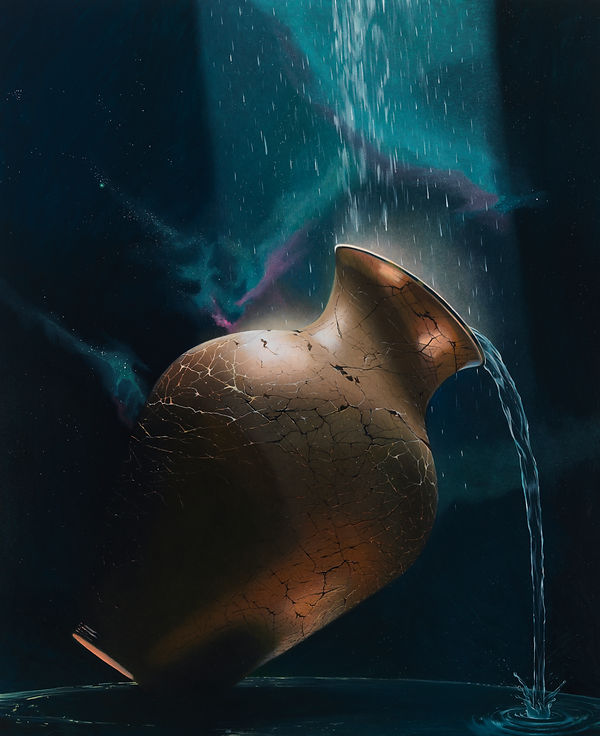
Cindy Bernhard
Lust, 2026
oil on canvas
72 x 60 in.

Cindy Bernhard
Wrath, 2026
oil on canvas
72 x 60 in.

Cindy Bernhard
Gluttony, 2026
oil on canvas
72 x 60 in.

Cindy Bernhard
Greed, 2026
oil on canvas
72 x 60 in.

Cindy Bernhard
Envy, 2026
oil on canvas
72 x 60 in.

Cindy Bernhard
Pride, 2026
oil on canvas
72 x 60 in.

Cindy Bernhard
Sloth, 2026
oil on canvas
60 x 72 in.

Cindy Bernhard
Holy Ghost, 2026
oil on canvas
72 x 60 in.

Cindy Bernhard
Holes, 2026
oil on canvas
40 x 30 in.

Cindy Bernhard
River, 2026
oil on canvas
18 x 14 in.

Cindy Bernhard
Creation, 2026
oil on canvas
14 x 18 in.